Skate 3 version for PC

Share
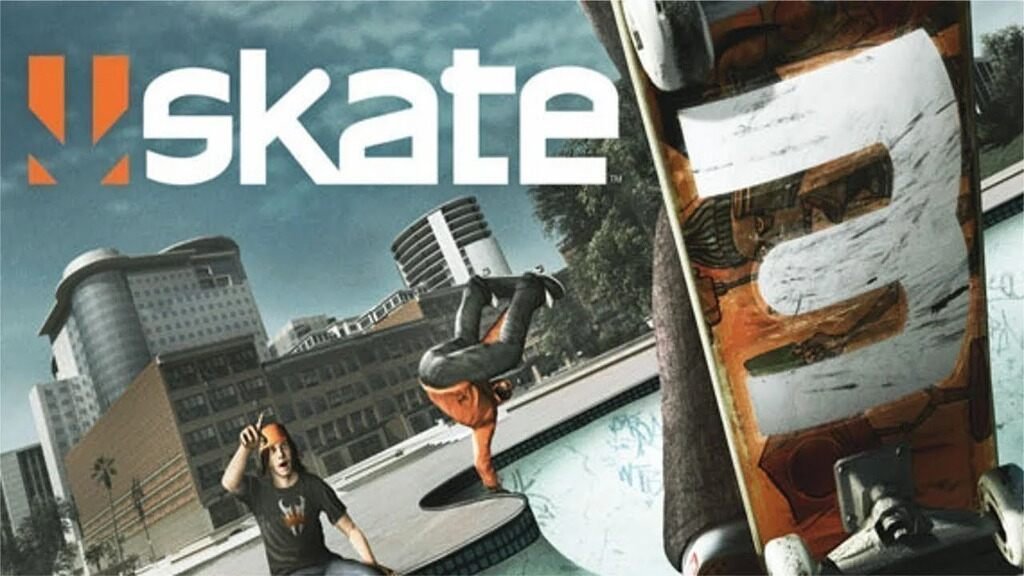
Skate 3 is a physics-driven skateboarding simulation developed by EA Black Box and published by Electronic Arts. Instead of arcade-style exaggeration, it builds its identity around control precision, weight distribution, and technical execution.
The game is presently accessible for Microsoft Windows on GamesKnit.
This article is for players who want to understand how Skate 3 actually plays, how deep its mechanics go, whether the multiplayer still matters, and why it remains relevant years after release. More importantly, it explains what makes it different from other extreme sports titles and why its design philosophy still holds up.
Gameplay Systems & Core Mechanics
Skate 3 is built on simulation principles. Every trick depends on balance, angle, speed, and body positioning. It does not reward button mashing — it rewards repetition and control awareness. The more time invested, the more the systems reveal their depth.
Flickit Control System
The defining feature of Skate 3 controls is the Flickit system. The right analog stick represents the skater’s front foot. Each trick requires a specific motion pattern rather than a simple button combination.
Kickflips, heelflips, hardflips, and advanced rotations require deliberate stick input and timing. Landing stability depends on alignment and weight distribution. Mistimed inputs result in incomplete rotations or unstable landings.
Physics & Momentum
Speed affects trick rotation, and surface type influences traction. The environment is not decorative—it directly impacts performance. Unlike arcade-style racing mechanics in Midnight Club: Los Angeles, where speed dominates regardless of terrain, Skate 3 demands micro-adjustments during every transition.
Physics Engine & Newtonian Mechanics
What separates Skate 3 from arcade-style extreme sports titles is its application of classical mechanics. The game’s behavior consistently reflects simplified versions of Newton’s Laws of Motion.
- Inertia (Newton’s First Law) is visible in every downhill approach. Once momentum is built, motion continues until friction, collision, or loss of balance interrupts it. Failed landings typically result from unstable body alignment rather than scripted randomness.
- Force and acceleration (Newton’s Second Law) influence trick execution. Greater push force increases speed, but added velocity alters rotation timing and angular momentum mid-air. Over-rotations and unstable landings are often the consequence of misjudged force application.
- Action and reaction (Newton’s Third Law) become apparent during collisions, ramp launches, and impact sequences. When force is applied against a surface, the resulting counterforce dictates lift, rebound, or bail behavior. Even exaggerated crash moments follow impulse-response logic rather than pre-set animations.
Surface friction further shapes performance. Rail slides, concrete transitions, and stair impacts each modify traction and stability, forcing players to adjust timing and weight distribution dynamically.
The result is a gameplay system that rewards mechanical awareness. Improvement comes from understanding motion, not memorizing button inputs.
Career Mode & Team Progression
Skate 3 is not just about individual skating. It introduces a brand-building system where players create a team and grow a skate company through sales milestones and competitive events.
Building Your Team in Skate 3
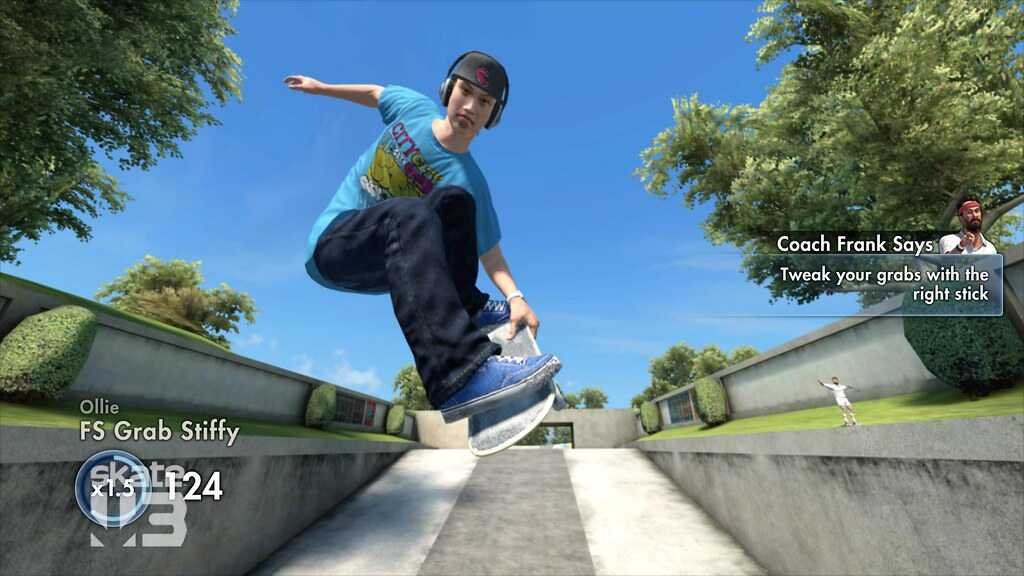
Players recruit additional characters to join their brand. This structured growth model mirrors the realistic sports career progression seen in Undisputed Day One, where long-term consistency defines success instead of quick victories. The “Coach Frank” element subtly introduces advanced techniques, encouraging players to refine execution over trial and error.
Challenge Variety
Events range from trick-based scoring competitions to team challenges and branded objectives. Difficulty scales naturally as expectations rise. The game avoids artificial stat boosts. Improvement is player-driven.
Multiplayer & Online Experience
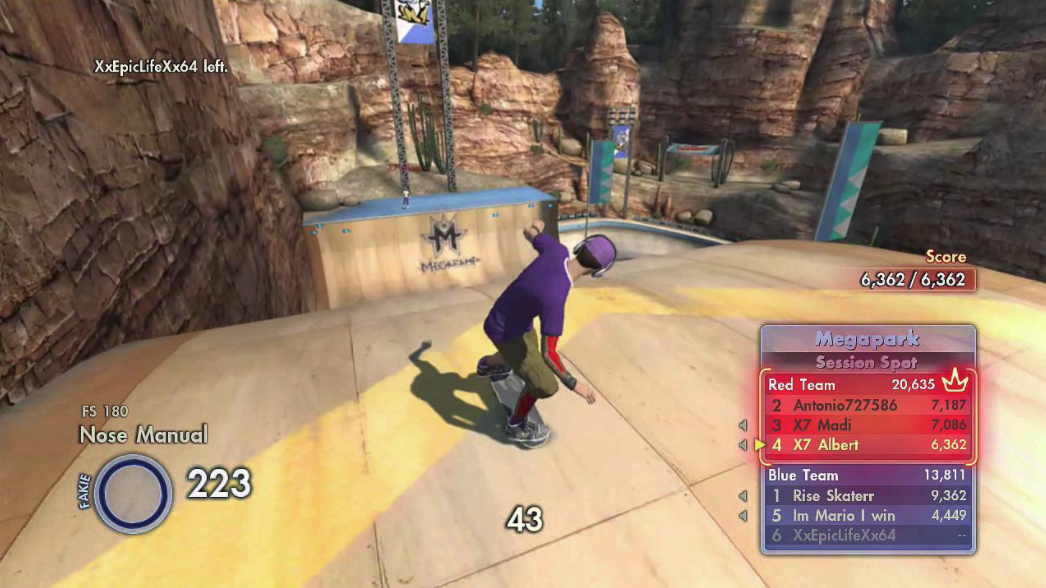
Skate 3 expanded its experience through online team competitions and community park sharing. Multiplayer revolves around collaborative goals and competitive score sessions.
Players can participate in team-based challenges, compare performance metrics, and build custom skate parks that others can download and skate. This community-driven design extended the game’s lifespan significantly.
While many players search for skate 3 pc multiplayer, the original online structure was built around its console ecosystem and social features.
Performance & Technical Stability
Skate 3 delivers stable performance with consistent physics behavior. Animation blending remains smooth, and ragdoll transitions — especially in Hall of Meat mode — feel responsive rather than scripted.
Collision detection is generally reliable, though complex stair sets and tight rail alignments can occasionally produce unpredictable bails. These moments feel physics-related rather than technically broken.
The game prioritizes mechanical integrity over graphical spectacle, which helps it age better than visually ambitious but mechanically shallow sports titles.
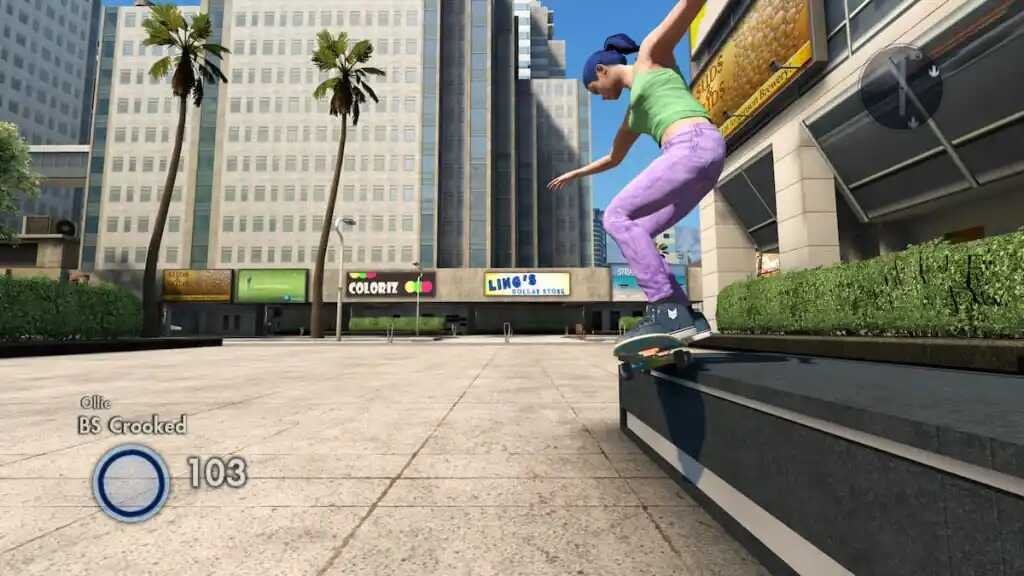
Endgame & Longevity for Skate 3
Skate 3 maintains replay value through skill refinement and creative expression. Completing the main career milestones does not exhaust its depth.
Long technical lines, custom park design, multiplayer score sessions, and self-imposed challenges provide ongoing engagement. Mastering advanced tricks like the skate 3 christ air consistently — without over-rotation or imbalance — remains satisfying even after dozens of hours.
From personal experience, after extended time in Skate 3, improvement feels measurable. The first time I successfully linked a downhill manual into a stair flip without bailing felt earned, not scripted. That sense of mechanical growth is what keeps players returning years later.
Pros & Cons
Every game has strengths and limitations. Skate 3 is no exception.
✅ Pros
- Deep, skill-based control system
- Physics-driven authenticity
- Strong community park sharing system
- Brand-building career progression
- High replay value through mastery
❌ Cons
- Steep learning curve for beginners
- Occasional unpredictable physics bails
- Limited onboarding for advanced techniques
- No major mechanical evolution from previous entry
The balance remains credible. The difficulty is part of its identity.
Final Verdict
Skate 3 succeeds because it respects physics and player skill. It does not simplify mechanics for accessibility, nor does it rely on spectacle to mask shallow systems. For players who value precision, repetition, and measurable improvement, Skate 3 remains one of the most mechanically satisfying skateboarding simulations ever made.
It rewards patience.
It rewards discipline.
And most importantly, it rewards control.
FAQ
❓ Is Skate 3 still worth playing today?
Yes. Its physics-based design and player-driven mastery system remain unique within skateboarding games. It rewards time investment and mechanical improvement rather than offering instant accessibility.
❓ Does Skate 3 have multiplayer?
Yes. It includes online team-based challenges and community park sharing features that extend replay value beyond the career mode.
❓ Can you play Skate 3 on PC?
Skate 3 does not have a native desktop build, but some players still run it on PC through alternative methods. The most common approach involves using console emulation software, which attempts to replicate the original hardware environment on a computer.
Keep in mind that this route depends heavily on your system specifications and proper configuration. Performance, stability, and compatibility can vary, and achieving smooth gameplay often requires technical setup and a relatively powerful PC.
❓ What are the most difficult tricks in Skate 3?
Advanced flip combinations and aerial extensions like the christ air require precise timing, speed control, and stable landing alignment. Execution becomes consistent only with practice.
IF YOU WANT SKATE 3 ON YOUR PC, CLICK ON:

INSTALLATION INSTRUCTIONS FOR SKATE 3 :
1. Unrar
2. Install the game
3. Open /Activation directory on your game install directory and take the registration code
4. Enter the registration code
5. Enjoy the game !
6. Support the software developers.
SKATE 3 SYSTEM REQUIREMENTS:
In order to play Skate 3 on your PC, your system needs to be equipped with at least the following minimum specifications:
- Operating System: Windows 7 and the KB3135445 platform update (64-bit)
- Processor: AMD Vishera FX-6350 3.9GHz or higher; Intel Pentium Dual-Core G4400 3.30GHz or higher
- Ram: 4 GB or more
- Free Hard Drive Space: 14 GB ore more
- Graphics Card: ASUS Radeon R7 250; NVIDIA GeForce GTX 750 or higher
- DirectX: Version 11
For the best Skate 3 PC download experience, however, we recommend having a system equal to or better than the following specifications:
- Operating System: Windows 8.1 (64-bit) or Windows 10
- Processor: AMD Six-Core CPU; Intel Quad-Core CPU
- RAM: 8 GB
- Free Hard Drive Space: 26 GB ore more
- Graphics Card: ASUS Radeon R7 250; NVIDIA GeForce GTX 750 or higher
- Graphics Memory: 2 GB
- DirectX: Version 11
Pro Tips for 2026 Players (Technical Guide)
Editor’s Technical Note (2026): Running Skate 3 on modern PCs is absolutely possible, but it requires smart configuration. Because the game was built for seventh-generation hardware, stability and performance depend heavily on how well you configure your emulator, drivers, and system environment.
CPU Matters More Than GPU
Unlike modern PC games, emulated titles depend heavily on CPU performance. A strong multi-core processor (Ryzen 5 / Intel i5 or higher, recent generation) will improve:
- Frame stability during dense city skating
- Physics consistency when chaining complex trick lines
- Replay editor smoothness
Your GPU still matters, but Skate 3 emulation is far more CPU-bound than most contemporary PC releases.
Install on an SSD
Even though the game size is relatively small by 2026 standards, installing both the emulator and game data on an SSD dramatically reduces shader compilation stutter and loading delays between districts. HDD installations can cause temporary freezes when new assets stream in.
Frame Rate & Physics Stability
Avoid forcing extremely high frame rates. While modern GPUs can push well beyond 60 FPS, Skate 3 physics were designed around console timing.
For best results:
- Lock the game to 60 FPS
- Disable experimental frame unlock patches unless you understand the physics implications
Uncapped FPS can cause animation desync, unpredictable board behavior, or inconsistent pop height.
Online Features in 2026
Official console servers are no longer active, but community solutions and private sessions may still function depending on emulator networking support. For most players, Skate 3 on PC is primarily a single-player and replay-focused experience.
Skate 3